
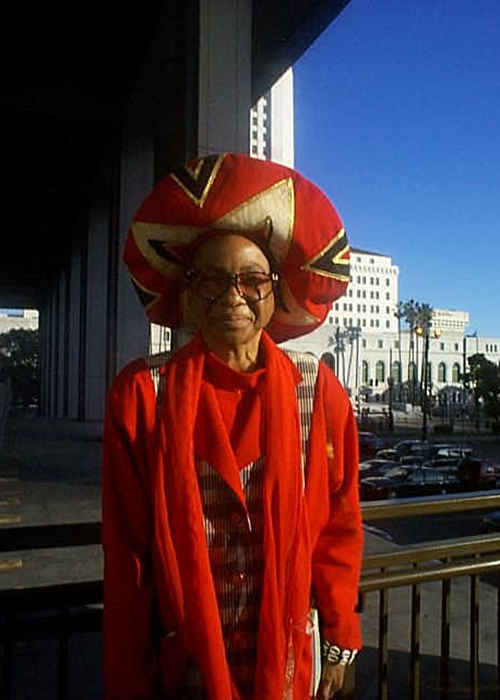
Today, the term “equity” has become a central focus in the movement to legalize cannabis, as state and local governments strive to create models for an adult-use market that address the social injustices caused by prohibition and the War on Drugs. However, this heightened public awareness is the result of the tireless efforts of individuals who have been pushing for change long before it was widely accepted. One such individual was Sister Somayah Kambui, a former Black Panther who became a vocal advocate for cannabis and racial justice. Tragically, before her passing, she achieved a groundbreaking victory in the form of “jury nullification,” which upheld her right to provide cannabis as a treatment for sickle-cell anemia.
Sister Somayah, also known as Renee Moore, used cannabis to manage her sickle-cell anemia after the passage of California’s Proposition 215 in 1996. However, her outspoken activism made her a target for law enforcement, ultimately leading to her unprecedented legal victory. Sickle-cell anemia is a rare genetic blood disorder that primarily affects individuals of African descent, causing severe pain, fatigue, and swelling in the hands and feet. It took Kambui some time to discover that cannabis was the most effective treatment for her condition.
Kambui was a veteran of the U.S. Air Force, having served during the Vietnam era. She received morphine for her pain from the disease at VA and public hospitals, but found it to be ineffective. In an interview with High Times reporter Peter Gorman, she stated, “I couldn’t do anything on the morph. And neither can a million other people. That’s why you see so many middle-aged and older black folks sitting on stoops looking like junkies. They are junkies. They’re U.S. government junkies.”
After realizing the benefits of cannabis and with the passage of Prop 215, Kambui founded the Crescent Alliance Self Help for Sickle Cell collective, also known as a “buyers’ club.” With a doctor’s recommendation, she began growing cannabis in her backyard in South Los Angeles. However, in October 2001, the police raided her garden and confiscated approximately 200 pounds of cannabis plants, using a helicopter to intimidate the surrounding neighborhood. Kambui told the Los Angeles Times, “I was sitting having a cup of coffee with a little hemp oil when they broke down the door. I said, ‘I’m legal, I have a doctor’s note, and I’m compliant with the law.'” Despite her compliance, she was arrested, spent 60 days in jail, and faced multiple felony charges, including cultivation, sale, and shipping of marijuana out of state.
Kambui disputed the police’s estimate of the amount seized, stating that it was 200 pounds of wet plants with dirt and stalks included. She also argued that she was growing for personal use and offered to let the police take what they believed was excess. However, they took everything. Kambui’s case brought attention to the flaws in the legal system and the disproportionate impact of drug laws on communities of color.
In conclusion, Sister Somayah Kambui’s courageous advocacy for cannabis and racial justice has left a lasting impact on the movement for legalization. Her groundbreaking legal victory and her tireless efforts to educate and empower others have helped pave the way for a more equitable and just cannabis industry.