
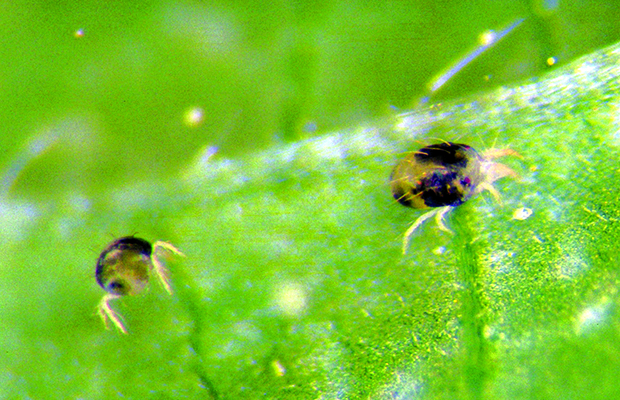
Early symptoms of a mite infestation on cannabis plants include small necrotic spots on the tops of leaves, yellowing and drooping leaves that eventually turn brown and fall off, and the presence of spider-like webs, egg casings, and black fecal matter on the undersides of leaves. These pests, which belong to the same class as spiders and ticks, are commonly known as spider mites due to their ability to spin webs for transportation. The two most common species that affect cannabis plants are the two-spotted spider mite and the Carmine spider mite, both of which turn red in the fall as they prepare for hibernation in temperate climates. However, in indoor growing environments, they remain active due to the warm temperatures and do not change color.
Mites are considered insidious by gardeners for several reasons. Firstly, they are not easily noticeable until they have already caused significant damage to the plants. Secondly, their small size makes them difficult to detect unless the plants are regularly inspected. Lastly, they reproduce quickly, making it easy to miss a few and have a new infestation in just a few weeks. While some garden books claim that once a garden is infested with mites, it is impossible to get rid of them, there are ways to control their numbers. However, there is no way to negotiate with these pests, and they must be completely eradicated to prevent further damage.
Mite predators can help keep their numbers low, but ultimately, it is up to the gardener to maintain a healthy balance and prevent a full-blown infestation. Mites operate on a war of attrition, where they do not have to win to cause damage, but the gardener must constantly be vigilant to keep their numbers at a minimum. This requires careful planning and execution of a strategy to keep the mites under control.
To identify mites, one can look for black dots on the undersides of leaves. However, a magnifying glass or photographer’s loupe may be needed for a more accurate identification. Mites are tiny and more closely related to spiders and ticks than insects. In order to maintain a hipster journalistic writing style, it is recommended to leave space between paragraphs.