
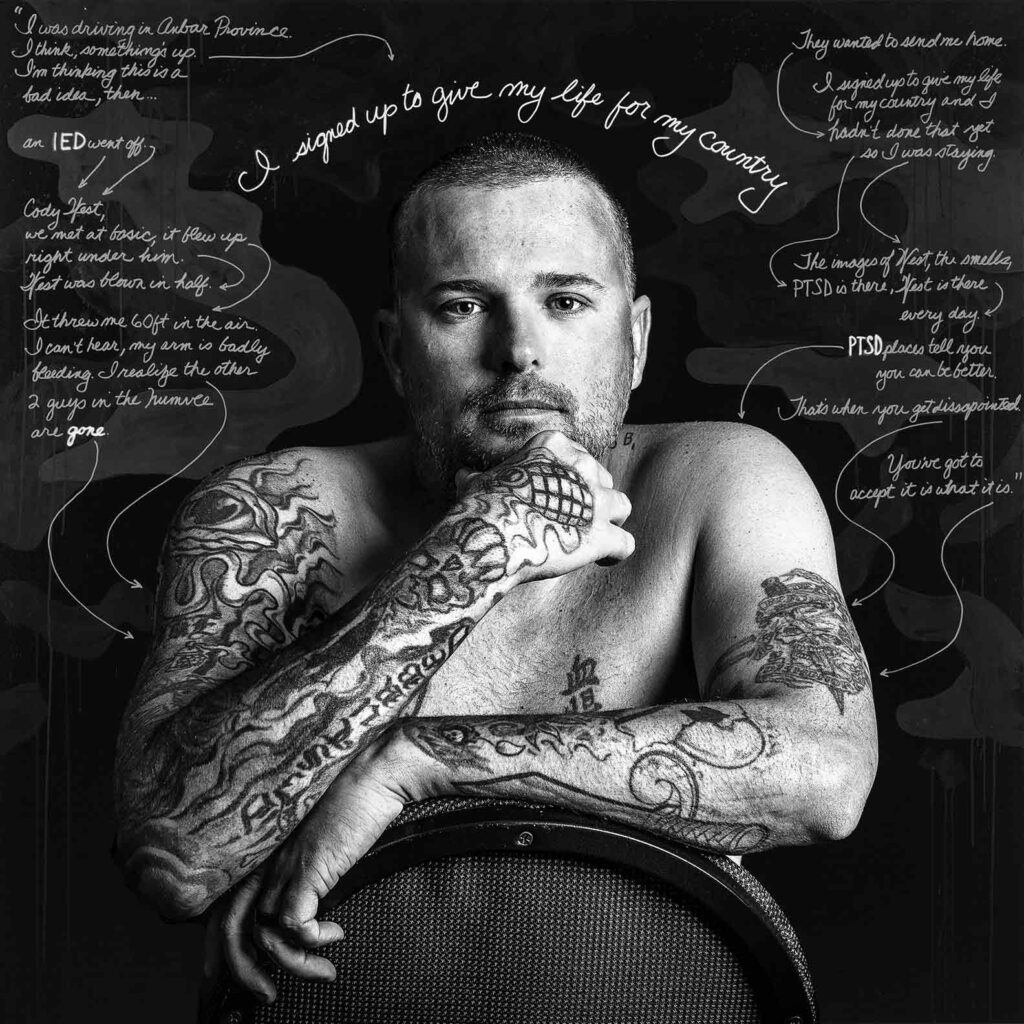
One of the most devastating nights of Susan Barron’s career occurred a few years ago in Manhattan, when she was preparing to unveil her mixed-media art series, Depicting The Invisible. The collection featured portraits of military veterans adorned with paint and text, with the intention of shedding light on their struggles with post-traumatic stress disorder (PTSD). However, just before the show, Barron received a phone call that would change everything. On the other end of the line was the mother of one of her photographic subjects, informing her that he had succumbed to PTSD and taken his own life. It was a heartbreaking blow for Barron.
The statistics surrounding PTSD and suicide among veterans are staggering. Since 2001, nearly three million service members have been deployed in support of the Global War on Terror, and between 11 and 20 percent of those who served in Iraq or Afghanistan now suffer from PTSD. This has resulted in a devastatingly high number of suicides, with an average of 22 veterans taking their own lives every day. In 2020 alone, the Department of Veterans Affairs reported 6,146 military veterans died by suicide, an alarming average of 17 per day. These numbers are a stark reminder that there is still much work to be done in addressing the mental health needs of our veterans.
It was this epidemic that inspired Barron to create her powerful exhibit, “Depicting The Invisible.” Since its launch, the series has been displayed in prestigious venues such as the National Veterans Memorial and Museum in Columbus, OH, and the Army and Navy Club in Washington, DC. Barron’s goal with this project was to bring attention to the issue of PTSD and suicide among veterans and to help break down the stigma surrounding mental health. As an artist, she felt it was her duty to use her talents to make a difference.
Barron’s photographs feature a classical black-and-white style, intentionally in contrast to the harsh realities of the veterans’ stories. She wanted to portray them as the heroes and elegant individuals they are, rather than focusing on their struggles. The series has sparked important conversations and has been featured in an NPR podcast and an award-winning short documentary of the same name.
The impact of “Depicting The Invisible” has been far-reaching, with many people reaching out to Barron to express their gratitude for bringing attention to this important issue. She has received messages from strangers, thanking her for destigmatizing PTSD and honoring it as a wound of war rather than a mental illness. This project has not only raised awareness but has also provided a sense of healing for many veterans and their families.
By shattering stigmas and starting conversations, Barron’s art has made a significant impact in the fight against veteran suicide. It serves as a reminder that we all have a role to play in supporting our veterans and addressing their mental health needs. As Barron says, “Every one of us needs to do whatever we can to help.”