Speaking with Shelley Johnson—known to her millions of followers as “A Good Witch”—feels like affirmation cards come to life, only less polished and far more entertaining.
“Being a whole person is not about judgment. Being a whole person is about accepting yourself.”
“You are divine and you are connected. Nothing on this earth can shake you.”
“What you think about me is none of my business.”
These are just a few of her mantras.
It’s only a few minutes into our Zoom call—how Johnson holds all her virtual tarot card readings—and I already feel better, calmer. At 73, Johnson has mastered something most people spend their lives chasing: the ability to be fully present.
But Johnson didn’t start becoming a “Good Witch” at 69, when her Instagram persona took off @agoodwitchofficial. For more than three decades, she worked as an occupational therapist, building her own practice in the 1970s—uncommon for a woman at the time—and helping patients who believed their lives were limited rediscover what was possible. Her methods weren’t always conventional. She used humor, blunt honesty and even tarot cards to better understand how to connect with the people she was treating.
“I’ve always asked the same question,” she says. “How do I get you to relax, enjoy, learn and grow?”
That question still drives everything she does today—it’s just packaged differently.
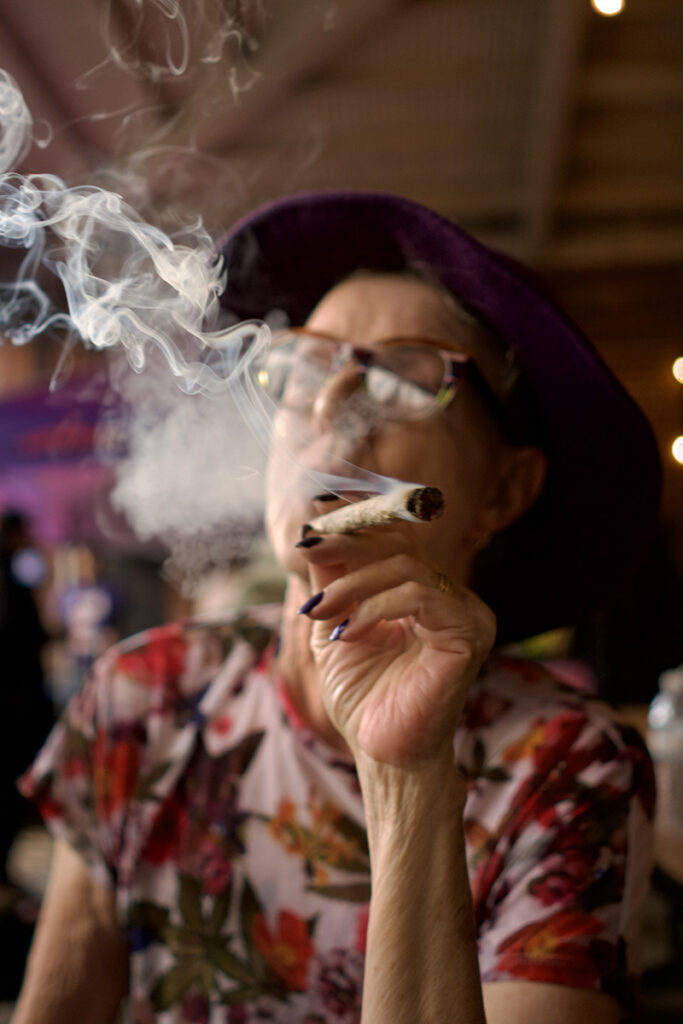
high priestess Shelley Johnson a.k.a. A Good Witch has built her following by trusting her intuition. “I’m not restricted to other people’s ideas,” she says. “I create the reality of my living.”
Scroll through Johnson’s social media, and you’ll find a mix of offbeat humor, cannabis content and hard-earned life advice. One moment she’s joking about smoking weed and sharing bong-cleaning tips; the next, she’s reminding viewers to love themselves exactly as they are—then baring her chest post-mastectomy, urging them to release shame around their bodies. It’s chaotic, a little disarming—and intentional. Cannabis, in particular, has helped her invite people in.
“I give you what you want, so you’ll listen to what I have to say,” she says, adding that her cannabis humor is meant to help people shed any shame around what she sees as a normal, regulatory medicine.
Johnson has been open about her relationship with the plant—starting young, getting sober for nearly two decades, then returning to it after a breast cancer diagnosis made pharmaceutical treatments unbearable. “I started smoking again at 50, quit the pharmaceuticals and stopped going crazy,” she says. “I’m not an insane bitch when I smoke pot.”
But she’s quick to clarify: Cannabis isn’t a cure.
“The cure-all is regulating the nervous system,” she says. “Pot doesn’t fix it—it helps it.”
This nervous system work’s something Johnson explored deeply after her cancer diagnosis in 2000. She stepped away fro