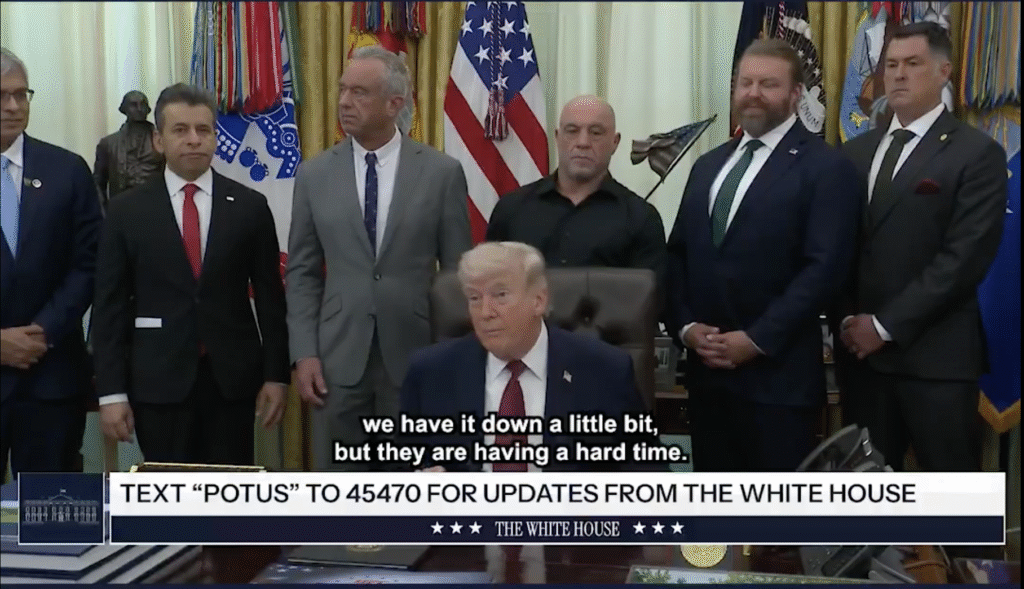
President Donald Trump used a White House press appearance on Saturday, April 18, to announce a new executive order aimed at accelerating federal research into psychedelic treatments for serious mental illness, with a specific focus on veterans living with PTSD and traumatic brain injuries.
The announcement comes just ahead of 4/20 and signals a notable shift in how the federal government is approaching substances that have long remained restricted under Schedule I drug policy.
Standing behind the president during the Oval Office remarks were Joe Rogan and Health and Human Services Secretary Robert F. Kennedy Jr., both of whom have publicly supported broader research into psychedelic-assisted therapies and have spoken openly about the need for new approaches to mental health treatment—particularly for veterans.
At the center of the executive order is ibogaine, a psychoactive compound derived from a West African shrub that has increasingly gained attention for its possible role in treating trauma, addiction, and severe mental health disorders. Veterans have traveled outside the United States for years, particularly to clinics in Mexico, seeking ibogaine treatment because access inside the U.S. has remained limited.
The White House order directs federal agencies to speed up research pathways and expand support for clinical study involving psychedelic compounds tied to serious mental health conditions.
The veteran focus is significant.
PTSD continues to affect a large portion of the veteran population in the United States, with many former service members reporting chronic anxiety, depression, sleep disruption, substance dependence, and trauma-related symptoms years after active duty. Suicide rates among veterans remain one of the most urgent mental health concerns facing the country.
That reality is one reason psychedelic research has gained momentum so quickly in recent years.
For many advocates, the larger takeaway from today’s announcement is not only about ibogaine—it is about what federal policy may be willing to reconsider next.
Because once the federal government openly supports accelerated research into Schedule I substances for therapeutic use, cannabis becomes impossible to ignore in that same conversation.
For years, cannabis has existed inside a contradiction: medically legal across much of the country, widely used by patients, openly relied upon by veterans in legal states, yet still federally restricted in ways that continue to slow large-scale PTSD research.
Veterans themselves have been saying this for years.
Across legal cannabis states, former military personnel regularly report using cannabis to help improve sleep, reduce hypervigilance, manage chronic pain, ease anxiety, and support daily functioning after trauma. While cannabis is not classified scientifically as a classic psychedelic like ibogaine, psilocybin, or MDMA, its therapeutic role in mood regulation and nervous system res