
By Brittany Vaughan
Something subtle has been happening inside dispensaries. It isn’t printed on menu boards or highlighted on product labels, but if you spend enough time listening at the counter, you start to hear it in the questions people ask.
A few years ago, the conversation was predictable: “What’s the highest THC you have?”
For much of the modern cannabis era, potency defined the experience. Dispensary menus functioned like leaderboards, with the strongest products placed at the top. The assumption was simple: Higher THC meant a better product. That question still exists, but increasingly, it’s being replaced by something more intentional.
“Do you have something relaxing but not too heavy?”…“Something that helps with stress?” … “Something that won’t make my brain race?”
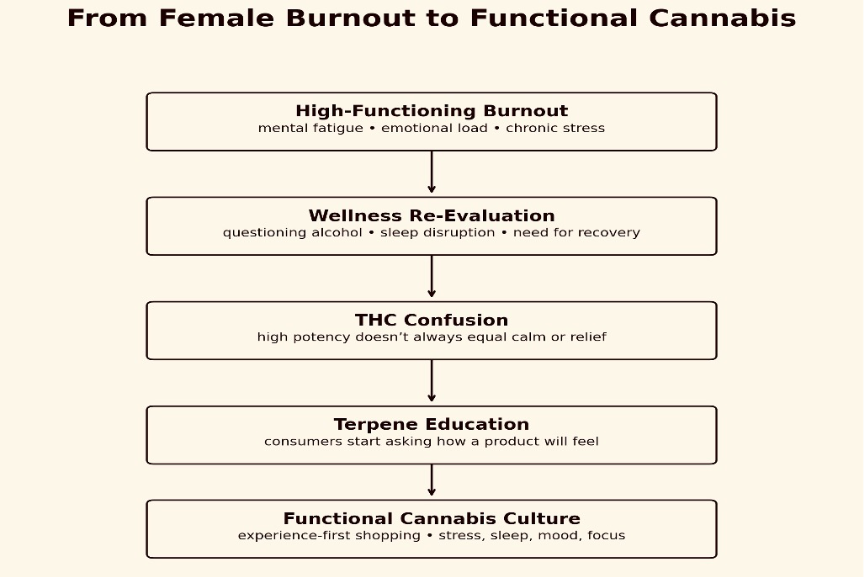
Feedback across legal markets suggests this shift has been gradual but unmistakable—and many industry observers believe one group is quietly driving it: women navigating burnout.
Burnout is often imagined as a dramatic breaking point, someone walking away from their job or collapsing under pressure. But for many women, it unfolds quietly. Deadlines are met. Emails are answered. Careers continue moving forward. From the outside, everything appears stable.
Inside, however, the nervous system tells a different story. The constant pressures of modern life, notifications, expectations and decision fatigue slowly drain mental energy. For women, that pressure is often compounded by emotional labor, caregiving responsibilities and the invisible coordination of daily life. The result isn’t just fatigue. It’s a persistent state of mental overload.
Psychologist Christina Maslach, who pioneered burnout research, defines it as “a prolonged response to chronic emotional and interpersonal stressors on the job.” Psychologists often describe this as cognitive load, the continuous mental processing required to manage multiple roles at once.
“Burnout happens when we get stuck in an activated stress response and never complete the cycle,” says Emily Nagoski, an expert on women’s sexual wellbeing and the author of The New York Times bestseller Come As You Are. “Women often experience burnout differently than men. Not just from professional demands, but from the cumulative weight of emotional labor and constant cognitive load. That kind of stress changes what relief looks like. It’s not about escape. It’s about regulation.”
That distinction is critical. For many women, cannabis isn’t about disconnecting or intensifying an experience. It’s about finding a way to regulate their nervous systems after a day spent in a heightened state of awareness.
But the way cannabis has traditionally been sold doesn’t always support that need. For years, THC percentage acted as a shortcut for quality, but many women eventually discover something