The federal government on Thursday officially reclassified regulated medical marijuana from Schedule I to Schedule III under the Controlled Substances Act, marking the most significant shift in U.S. cannabis policy in more than 50 years.
The order, first reported by Associated Press, was signed under the Trump administration earlier today after months of accelerated pressure inside the Department of Justice. It immediately changes how cannabis is defined under federal law—formally acknowledging its accepted medical use for the first time since 1970, though it stops short of full federal legalization.
“Today’s rescheduling of cannabis marks a historic turning point for the industry and a long-overdue modernization of federal policy,” said Darren Lampert, Chief Executive Officer of GrowGeneration Corp., a retailer focused on hydroponics, cultivation equipment, nutrients, lighting systems and infrastructure used by both commercial growers and serious home cultivators. “It recognizes the legitimate medical value of cannabis, supports expanded scientific research, and removes barriers that have constrained responsible businesses and patient access for years.”
Lampert added that the shift could have immediate ripple effects across the broader cannabis economy.
“This decision creates a stronger foundation for investment, innovation and job creation across the supply chain,” he said. “For companies like GrowGeneration, which support cultivators and operators nationwide, greater regulatory clarity will help accelerate growth and efficiency throughout the market.”
For the first time since 1970, Washington is no longer officially maintaining that licensed medical cannabis has no accepted medical value. That matters because, for more than 50 years, the federal government placed marijuana in the same category as heroin, despite nearly 40 states building medical programs, millions of patients legally using cannabis, and years of scientific evidence pointing toward therapeutic value.
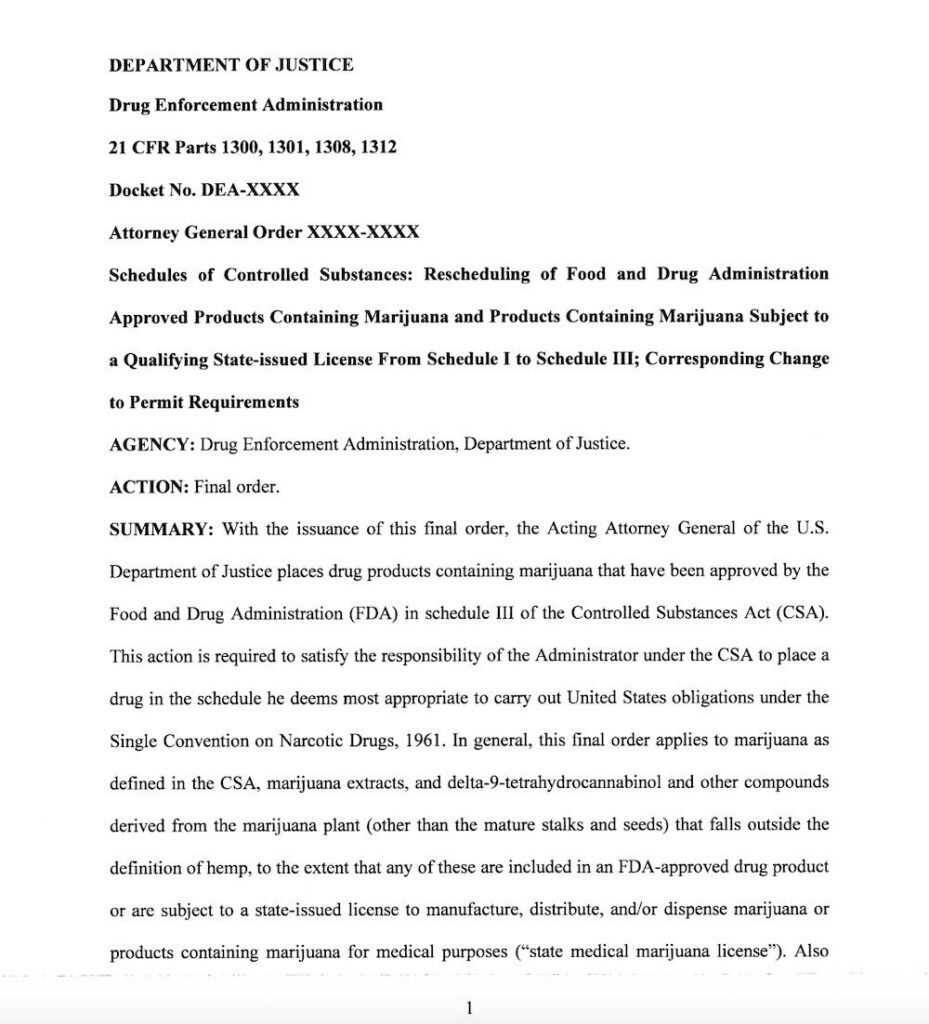
The DEA order, obtained exclusively by Cannabis Now from the White House, formally acknowledges what much of the country has already accepted: Cannabis is no longer being defined by federal law in the same way it was during the height of prohibition.
A preview of the DEA order.
“This is a meaningful step forward—and a long overdue acknowledgment of reality,” said National Hemp Association Chairman Geoff Whaling. “While this action does not directly impact hemp—already removed from the Controlled Substances Act under the Agriculture Improvement Act of 2018—it is another significant step in normalizing the broader cannabis category. And that matters.”
A Long Road to Recognition
For the cannabis community, today carries emotional weight beyond policy.
For decades, activists marched, patients testified, families fought for access, and entire communities built legal cannabis markets while people were still being arrest