
The moisture percentage of marijuana is a crucial factor to consider, but the exact changes in this percentage during the drying, curing, and packaging stages are often unclear and subjective. In my book “Marijuana Harvest,” we offer various methods for determining moisture levels throughout the post-harvest process. However, these methods are not entirely objective, and the community relies on them due to the lack of a better system. When I asked bud processors about this issue, some had theories about the ideal moisture content for cannabis, but few were willing to give a specific measurement. Processors also had theories about the appropriate humidity and temperature for drying, curing, and storage areas, and many use automatic climate control to regulate these factors.
One way to measure the moisture percentage of a leaf or bud is to weigh a small amount and place it in an oven at 80 degrees until it becomes dry and crispy. Then, the difference between its pre-oven weight and post-oven weight is divided by the original weight of the wet material to determine the percentage of moisture. For example, if 100 grams of dried, un-manicured buds were weighed and then placed in the oven, resulting in a weight of 91.5 grams, the moisture percentage would be 8.5 percent.
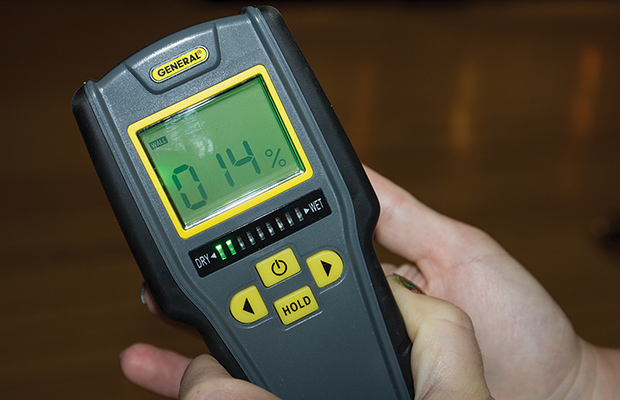
While there is currently no objective tool available for this task, recent experiments have shown that a wood moisture meter can be used to measure moisture content accurately. I have been using a meter with a touch pad, and it has provided consistent readings based on the subtractive test described above. There are different types of moisture meters available, but I have found that the ones with two probes, about 1-1½ inches apart and sticking out less than half an inch, and a touch pad sensor, provide the most accurate results. Setting the meter on the “softwood” setting and holding the material firmly against the pad with a piece of hard plastic yields the most precise readings, which only take about a second. Even if the exact number is not entirely accurate, as long as it is consistent, it can be used as a standard.
In the cannabis community, there is a widespread belief that 12 percent moisture is the ideal level for smoking in a joint that won’t go out, and it is also the point at which small sticks snap audibly. If the meter has been tested against these two subjective but reliable tests and consistently reads 12 percent, then all is well. However, if the meter gives a different reading, as long as it is consistent, it can still serve as a reliable measurement. In conclusion, an objective tool for measuring moisture content would greatly benefit processors, providing a more accurate assessment without requiring the skill of an artisan, just the trained eye of a worker.