
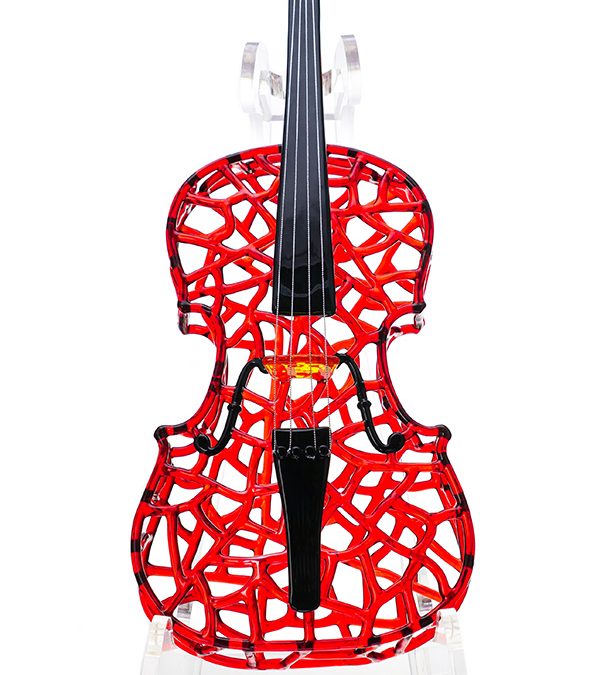
Flows drop degrees, all my clothes got the scent of trees
I lay back and blow sax like Kenny G
—“Heavenly Devine,” Jus Allah, Jedi Mind Tricks
Musical instruments exist on an ever-shifting cool continuum: Electric guitars are cool as hell—not as cool as they were at “peak electric guitar” in 1984[*]—but still undeniably cool; tubas are objectively lame, and scientists confirm they always have been[†]. Then there’s the saxophone, which defies cool categorization: It rides the razor’s edge between cool and cringe, like Pee Wee Herman dancing across a bar top to the roaring, guttural groove of a crunchy baritone sax riff—Tequila, anyone?
With its iridescent, shimmering gold body and obsidian-hued keys to match the tar-black interior of its perfectly flared bell, it may not look like any other saxophone you’ve ever seen, but Etai Rahmil’s latest glass creation absolutely does look like a saxophone. That’s no accident: It’s a two-foot-tall scale replica of an actual saxophone that Rahmil meticulously diagrammed before painstakingly hand fabricating each piece of its arabesque anatomy over a 5,300-degree torch flame.
“I always purchase the instrument I’m replicating—I had a real saxophone sitting in front of me,” Rahmil says. “I took out a sharpie and started numbering the order pieces had to go on over each other…that saxophone I made was such a puzzle.”
Smokeable Creations
From the unmistakable sweeping curvature of the bell and elbow to the mechanical intricacies—including the ligature holding the reed into the mouthpiece—each glittering glass component represents a victory of the artist’s vision over the obstacles presented by his notoriously frail and fickle chosen medium; the sum is a glimmering triumph of imagination exceeding the limitations of Newtonian physics.
Also—and I really can’t stress this enough—you can smoke weed out of it.
Go watch the 1987 film The Lost Boys, specifically the scene with an oily, shirtless Tim Cappello belting out sexually charged saxophone pyrotechnics to the backdrop of teenage vampires embroiled in high-stakes romantic rivalry on the Santa Cruz Beach Boardwalk. Until recently, there was broad scientific consensus that it was mathematically impossible for that scene to be any cooler.
Rahmil’s research has revealed that if Cappello had ended that scene by taking a massive rip of chronic from the bell of his sax, it would have made the whole film roughly ten billion times cooler.
“You can’t play them, but you can smoke out of them,” Rahmil says. “Hopefully, that’ll help you hear music more clearly. I feel like I’m trying to change the function—not just making something out of glass just to make it out of glass.”
That fusion of form and function doesn’t occur naturally; it’s the product of countless hours spent honing the foundational techniques of your craft.
“It took a few good years for