
The shuttle ride to the Brinkerhoff Family Farm in Parachute, CO, transports us through tree-lined canyons where foliage graduated from vibrant greens to burnished amber, alongside shallow rivers revealing streambeds painted in blue and purple hues—a living testament to Colorful Colorado.
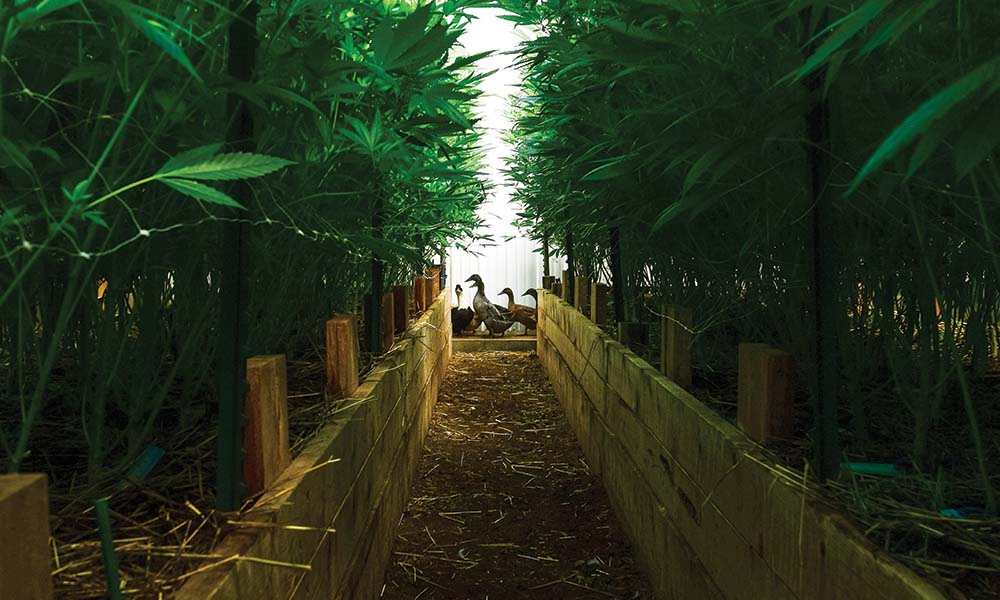
The scenery feels important when thinking about how Edun is different from most of the state’s other cannabis grows. What you see in their cultivation—grass, pepper plants, decomposing leaves, roly poly husks and even ducks—is built from the very land I happen to be riding through. And the wildness and authenticity of their process is present in dancing leaves, hearty stems, crystallized flowers with neon hues and zero visible stress. In a Colorado market littered with shuttered dispensaries and questionable operations, Edun is showing up with a prohibition-era cultivation method that most commercial growers abandoned years ago.
Before entering the grow facility in the small mountain town of Parachute, situated on the Western Slope of the Rocky Mountains approximately 40 miles east of Grand Junction and 200 miles west of Denver, Edun Founder James (Jimmy) Brinkerhoff highlights the wild grasses shimmering with morning dew around the nondescript buildings. “We’re starting a new garden over here where we’re growing rhubarb, which will make fermented plant juice that we feed to our plants every week in a blended tea,” he says.
This isn’t your standard coco-coir-and-bottled-nutrients operation. Edun is a no-till regenerative farm utilizing Korean Natural Farming (KNF), an organic cultivation method that relies on natural inputs and biological functions to create a healthy biome. The approach includes Fermented Plant Juice (FPJ), a fertilizing system common during cannabis prohibition because it was completely untraceable, renewable and provided excellent nutrients and disease resistance. The same fermentation process is used to make kimchi.
At its core, KNF is beneficial because it allows plants to grow and thrive as if in nature. Plants develop better resilience to pests and disease because the habitat is influenced by the same mechanisms as a wild outdoor garden. The soil is rich, nutrient heavy and sustained through processes requiring little intervention. Consequently, no pesticides, fungicides or chemicals are used at Edun.
Brinkerhoff describes the gathering of Indigenous Microorganism (IMO) as he points to the surrounding valley. “We go up a couple thousand feet with these boxes filled with rice and holes in them,” he says. “We put them out for two or three days. The microbes go inside and start multiplying in the rice.” These collected microorganisms are then combined with FPJ and other ingredients in a brew room before being distributed to the facility’s four cultivation rooms, where the real evidence of this system lives.
Walking through the doors, the first thing you notice is what’s missing: no coveralls,